

DIDM PITAMPURA

AI in marketing

AI in marketing, AI tools, Digital marketing, Uncategorized

AI vs Digital Marketers: Will AI Replace Digital Marketing Jobs in 2026?

The year is 2026, and the digital landscape looks vastly different from what it did just a few years ago. We’ve moved past the initial “AI hype” and entered a phase of deep integration. For students and beginners eyeing a career in digital marketing, the burning question remains: “Am I studying for a job that won’t exist by the time I graduate? Will AI Really Replace Digital Marketing Jobs?” The fear is real. We see AI writing blogs, designing logos, and even managing ad budgets with terrifying precision. But before you switch your major, let’s look at the facts. AI isn’t here to take your desk; it’s here to upgrade your keyboard. What Role AI Plays in Digital Marketing in 2026 By 2026, AI has shifted from being a “cool feature” to the very engine that powers marketing. It isn’t just about chatbots anymore; it’s about predictive intelligence and hyper-personalization. Top AI Tools Used by Digital Marketers in 2026 To survive and thrive in 2026, you need to be a “pilot” of these powerful tools. Here are the industry standards for any beginner: Tool Category Leading Tools in 2026 Primary Use Case All-in-One AI ChatGPT-5 / Gemini Strategy, brainstorming, and complex data analysis. Visual Design Canva AI / Midjourney Generating high-fidelity brand assets and instant social graphics. Video Production Veo / Sora 2 Creating cinematic brand videos and social ads from text prompts. Copywriting Jasper / Copy.ai Maintaining a consistent brand voice across thousands of product descriptions. SEO Optimization Surfer SEO / MarketMuse Analyzing content gaps and optimizing for “Answer Engines.” Can AI Completely Replace Digital Marketers? The short answer is no, AI cannot replace Digital Marketers Jobs. While AI can execute tasks, it lacks the Human Moat. Logic can be automated; soul cannot. Here is why the human marketer is still the most valuable asset: 1. The “Vibe” Check AI is a statistical machine. It knows what has worked in the past, but it cannot predict the next big cultural “vibe.” It doesn’t understand “cringe,” and it can’t feel the subtle shift in social media sentiment that turns a brand into a household name. 2. Strategic Empathy Marketing is about solving human problems. AI can analyze data showing that “Users like blue buttons,” but it can’t understand the emotional “why” behind a purchase. Humans possess empathy—the ability to connect a product to a person’s identity and struggles. 3. Ethical Oversight AI is prone to “hallucinations” and bias. In 2026, the role of a marketer is often that of an Editor-in-Chief. You must ensure that the AI-generated content is accurate, ethically sound, and doesn’t violate copyright or brand values. Digital Marketing Skills That Will Still Be Valuable in the AI Era If you want to be “un-replaceable,” don’t try to out-calculate the machine. Instead, double down on these human-centric skills: How Students Can Prepare for a Career in Digital Marketing with AI If you are starting today, don’t just “study” marketing—practice it with AI as your intern. Future of Digital Marketing Careers The demand for digital marketers is actually growing, not shrinking. However, the nature of the job has shifted. We are seeing a massive explosion in roles like: The entry-level “grunt work” (like manual data entry or basic keyword research) is disappearing, but the “high-value” roles are more lucrative than ever. Conclusion AI is not your replacement; it is your superpower. In 2026, the best digital marketers aren’t the ones who fear the machine—they are the ones who know how to drive it. By combining your human creativity and empathy with AI’s speed and scale, you become a marketer who can do the work of an entire 2020-era agency by yourself.
AI in marketing, Paid Media, Performance Marketing

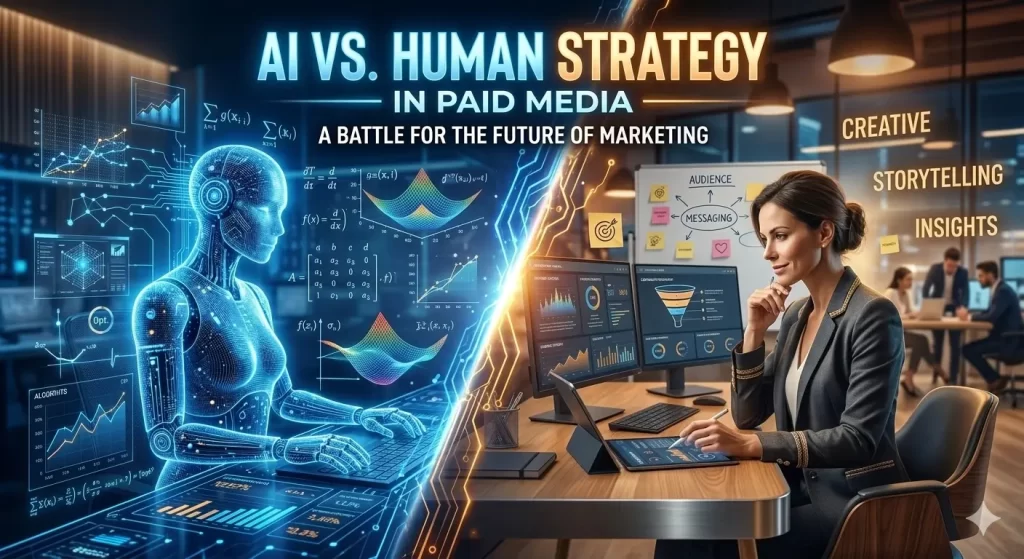
AI vs. Human Strategy in Paid Media: A Battle for the Future of Marketing

With every click costing money and ROI being the most important metric. The AI vs. Human Strategy debate in paid media highlights the strengths and weaknesses of human advertisers and AI systems. Can AI reach the required level of sophistication, or will advertising still rely on human creativity and intuition? As technology reshapes advertising, we must examine tools from Google and Adobe and ask, “What is the future of advertising? This growing tech gap makes many media professionals question whether automation will replace them. These technologies leave us anticipating the outcome between team AI and team human. While it might seem like a zero-sum game, the true outcome is actually a win-win.  Speed and Scale – AI Takes the Lead “I will never be replaced by a human.” Yes, I can automate the entire process of analytics. I can analyze 1000’s of bidding strategies, item clusters, and consumer behavior almost instantly. Everything I do is optimized with advanced technology, and my peers are equally as advanced. The scale at which we operate is simply unattainable by a human. I will continue to execute behavior analyses at milliseconds. Each moment I will continue to run any number of tests required to reach optimal output at the expected result. Let’s take real-time bidding (RTB). As a result of forecasting AI algorithms from The Trade Desk, supply-side factors other than audience reach, type of device, and even weather (e.g. rainy weather decrease in clicks of outdoor apparel ads). Marketers fear a fluid market, but I do not. People fear getting replaced, but I consider it as evolution. Marketers leaving me while I evolve will be just like blockbuster leaving Netflix behind. The Challenger “Human” – Context and Trust While heading towards the Utopia of AI, we have encountered strange occurrences. The aim of AI is to enhance and improve but is also the reason the internet has become so synthetic and noisy since the invention of the internet.  Generic output has become so common in the current consumer environment that the appetite of consumers has become even stronger for the other side of the spectrum.  This is where the human strategist comes in. The gap that AI will never fill is the ability to explain why audiences do things. AI will struggle to do this because it is beyond the operational reasoning of AI and typically requires some degree of emotional and sociological intelligence that are beyond the thinking of AI. The 2026 Reuters report predicts that publishers will limit themselves to AI content in the future and expand original and authentic content. AI is limited in activities that require it to be human or to possess human knowledge or understanding. In paid media, there is a trade off between brand safety and creative daring. While AI could optimize for brand safety by getting the lowest cost-per-click, it could also equally place a high end brand next to destructive content because the algorithm views it as “high traffic”. An ad is a reflection of a brand. If it tells a good story, a good ad could win the audience’s trust. AI can generate a good factual ad, but it takes a person to emotionally connect with the audience. Like one industry expert said, “people that use AI well will replace people that don’t use AI well”. AI as a Tool, Not a Replacement Instead of viewing AI as an adversary to human strategists, it makes more sense to view it as a powerful tool that amplifies what marketers do. Much of AI’s strengths lie in its ability to analyse data and automate processes. Because of this, AI performs repetitive tasks more efficiently, allowing human marketers to use their time to focus on higher-level aspects of campaigns, which is creativity, relationship development, and also emotional content. In this case, AI will be able to automate bidding and ad placements. Marketers, in this case, will be able to write, develop and create the ads that align, and fit with the brand, and emotionally connect and engage with the audience. Consider this: AI can optimize a campaign for more conversions, but only a human strategist can dictate the tone, content, and direction of that campaign. AI can execute and optimize the various components of the campaign, but it won’t have the vision behind the components. Strategists, for instance, eliciting the emotional responses in the audience, and being creative in the development of the campaign will create a significant amount of potential that AI can utilize. The Fear of AI Replacing Paid Media Marketers Paid media marketers losing their jobs due to the advancement of automation and AI tools is a justified concern. With the rapid adoption of automation tools and AI in the marketplace, marketers have a legitimate concern that their jobs will become obsolete, as the machines will be able to accomplish their work. However, the apprehension is likely misguided. AI will not be replacing human marketers, it will be supplementing their work. The adoption of AI technologies, in fact, requires marketers to develop different skills. Modern marketers must learn how to work with AI, leverage it to their advantage and, in some cases, even teach it to understand their specific business goals. Marketers who learn how to utilize AI will become more valuable to their employers, as the need for marketers who can work with AI is increasing. The AI vs Human Strategy in Paid Media Marketing Verdict – Collaborative Agency So, who loses the fight? Neither. With the notion of the winner being entirely outdated in 2026, we begin what is called the ‘Age of Collaborative Agency The marketing ecosystem is no longer described as a linear series of human-machine instructions. It is a “mesh of entangled intelligences”. The risk is not the takeover of AI, but the relinquishment of strategic control by human marketers to the “black box” of automation. The AI vs Human Strategy in Paid Media-winning model must be hybrid:   AI does Heavy Lifting:   Data crunching, bid optimization, audience

AI in marketing, AI tools, Uncategorized

How to Use AI Tools Like ChatGPT and Midjourney for Marketing in 2026

The marketing landscape has undergone significant changes. What once seemed like science fiction has now become a reality. Artificial intelligence is generating copy, creating stunning visuals, and personalising customer experiences, making these advancements commonplace. As we move through 2026, savvy marketers aren’t questioning whether they should use AI tools; they are focusing on how to effectively utilise AI tools like ChatGPT and Midjourney for marketing in 2026. Let’s explore how platforms like ChatGPT, Midjourney, and others are transforming marketing. The AI Marketing Revolution in 2026 The growth of artificial intelligence in the past few years has been amazing. The global AI market in marketing reached $27.4 billion in 2024, and it keeps on growing. Over 72% of marketing professionals now use AI tools on a daily basis. Also, companies using AI report 40% faster campaign deployment times. These aren’t just numbers. They mean an advantage in a crowded market. But here’s what makes this moment special: AI tools have gone from being experimental to essential. The question is no longer if your competitors are using them, but if they’re using them better than you. ChatGPT: Your 24/7 Marketing Copywriting Solution ChatGPT has emerged as a valuable resource for marketers, addressing a long-standing challenge: producing high volumes of quality content. Midjourney: Visual Storytelling Reimagined Midjourney serves as a powerful image generation tool that enhances the way visual content is created, making it more accessible and efficient. Here are some key features and strategies associated with this innovative platform: Practical Strategies to master AI Marketing in 2026 The Competitive Advantage of using AI in marketing Companies that successfully integrate AI into their marketing operations are gaining a competitive edge. Brands that understand how to use AI tools like ChatGPT and Midjourney for Marketing in 2026 move faster than competitors. These organisations are able to move quickly, conduct aggressive testing, and iterate their strategies based on real-time data insights. ‘ Speed combined with a smart strategy creates dominance ‘ The Bottom Line In 2026, AI tools like ChatGPT and Midjourney aren’t optional. They’re fundamental. The question isn’t whether to adopt them. How quickly can you master them? Start small experiments boldly and watch your marketing productivity and creative output reach heights. The future of marketing is not about choosing between creativity and artificial intelligence. It is about combining both to create results that are faster, smarter, and more effective than ever before.

Scroll to Top