Why Paid Ads Are Getting More Expensive in 2026. And How to Fix It
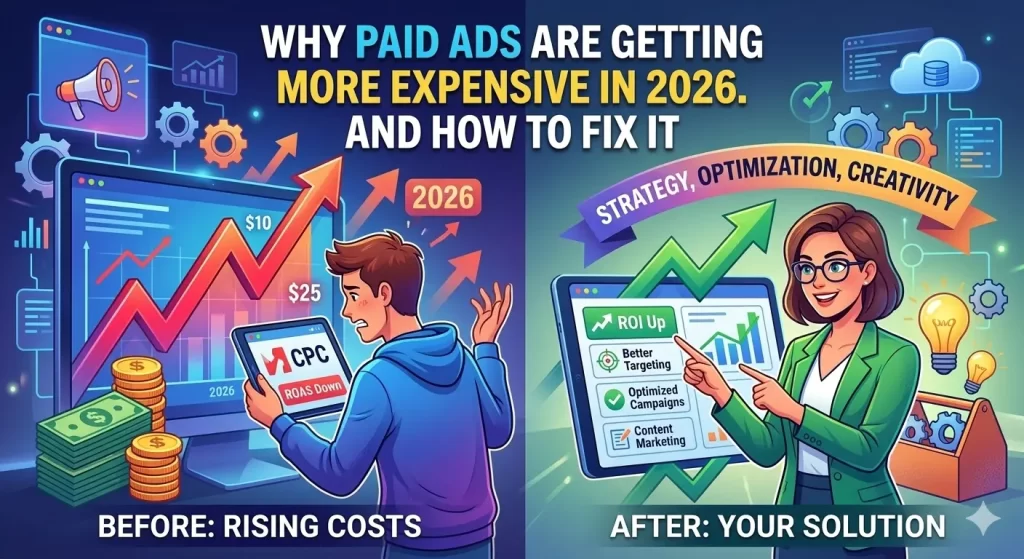
Paid Ads Getting More Expensive. The golden age of cheap clicks is officially over. Managing digital ads lately has been a challenge. Your budget that has consistently brought you leads is now burning in a shorter time frame in greater amounts, and obtaining a single customer is more expensive each quarter. Advertising costs are increasing due to a perfect storm of economic changes, changes to ad platforms, and changes to technology. Digital marketers need to understand the how and why to develop proficiency and understanding of modern media. The Perfect Storm Behind Rising Digital Advertising Costs Increased Cost Per Click (CPC) is more about the structure of the digital ad ecosystem, rather than just how inflationary pressure is affecting the economy. Increased Competition Driving Up Paid Ad Costs The simplest and most straightforward answer is that there are just more advertisers in the marketplace. The most underlying cause of the cyclical downturn is economic recession, and in this case, the driving force is the demand outstrips supply. Digital ad spend grows year after year. It is unique to this new economy. There are more and more buyers in the digital ad marketplace.Data from across the industry shows that CPCs across all large platforms are 20–40% greater than 2 years prior. In competitive industries like SaaS, legal, and healthcare, keywords that previously cost only a few dollars have increased in cost, increasing customer acquisition costs across the board. Decline of Organic Reach Is Forcing Businesses Toward Paid Ads Paid clicks dominate competitive advertising opportunities because businesses have no choice. Hidden Budget Leaks That Make Paid Ads Even More Expensive Two factors, that must be addressed in order to optimize results control your spending, and cost you a great deal of money. The AI Bidding Black Box in Google and Meta Ads Paid Ads Getting More Expensive. The AI platforms work for and against you. In a fundamental way, Google’s move to Performance Max and Meta’s move to automation have increased the complexity of managing your budgets. These AI systems need an enormous amount of data to ‘learn.’ Budget restrictions or insufficient data tracking lead to the AI system making very broad and highly expensive assumptions that fail to differentiate between prospecting and remarketing by bidding on users that are not going to buy. This means you are paying high costs for traffic that the algorithm deems valuable but which has no likelihood of conversion. Poor Targeting Drains Your Budget Out of Control In 2026, efficient or sophisticated targeted advertising will seem like a miracle. Targeting by broad interest categories or by a manual CSV upload will likely waste as much as 50% of your remaining budget. Smarter Advertising Strategies to Reduce Rising Ad Costs The answer is not to stop advertising, but to start advertising smarter. To combat ever-increasing costs and to eliminate waste, your advertising must be smart. Feed the AI, Don’t Fight It It is impossible to defeat AI algorithms, but, within the advertising platform, you are able to control the algorithm. You must give the algorithm what it requires. Sharpening conversion tracking accuracy takes precedence. Automated bidding requires 15 to 30 conversions a month to learn effectively. When utilizing Performance Max or Meta Advantage+, provide as much high-value information as possible regarding search themes, audience signals, and a wide range of creative resources. Why First Party Data Is the Future of Paid Advertising In today’s privacy-centered era, your business’s customer information is invaluable. Implement a real-time CRM and advertising platform synchronization tool. Automatically exclude current customers and active opportunities from prospecting campaigns. One business used dynamically automated exclusion lists to bring their LinkedIn CPL down from $250 to $25. On Meta, personalize the matched email addresses to the customer, increasing the match rate from 30 to over 70%, ensuring an effective lookalike audience. Transform Your Creative Strategy In 2026, the key to optimization cost is creative diversity. Very small accounts (<$2k/month) should refresh creative monthly. Larger accounts (>2k/month) should refresh creative weekly. If CPMs are rising with no other changes, it is probable that the creative is fatigued. Meta’s Dynamic Creative tools can be used so that advertisers can upload multiple creatives (images, videos, headlines, and texts) and the AI can optimize and find the best combinations for the best users. This can dramatically reduce the cost of ads. In one instance, the cost of ads dropped from $86 to $13.87 per conversion. When creating LinkedIn ads, it is important to create ads with more than just a sales pitch. Use story-telling and “thought leader” ads that educate and offer insight as they are much more successful than traditional ads. Full Funnel Marketing Strategy to Control Paid Advertising Costs I understand it is tempting to cut upper-funnel budgets. This is a mistake. Allocate 20-40% for demand creation including YouTube, TikTok, and native ads. Cutting upper funnel budgets to over focus on lower funnel (last-click) budgets like branded search may look good in the short term, but it starves your future pipeline. In a time of experimentation, it is best to allocate 5-10% to try new platforms, creative formats, and audience strategies. Diversification Strategies to Reduce Dependence on Paid Ads Open your paid advertising budget and invest it in channels that compound (save in the long run). Optimize your AI-optimized content for traffic. This increases your brand mentions to give you traffic in a world with increasingly little click activity. Organic search will give you the search ROI you have been looking for. Paid search costs are rising, so focus on a search that will build your authority on a topic and structure the content for AI readability. Paid Ads Getting More Expensive — But Smart Marketers Will Still Win The age of inexpensive, simple traffic generation is at an end. However, marketing that is intelligent and profitable is still possible. Winning brands in 2026 will not be those with the largest budgets, but rather those with the most effective strategies. With a good understanding of AI, a focus on creativity and the smart use of first party data, all of the concerns over increasing costs and