
DIDM PITAMPURA

paid media marketing

Facebook ads: step by step guide
Digital marketing, Facebook Ads, Performance Marketing

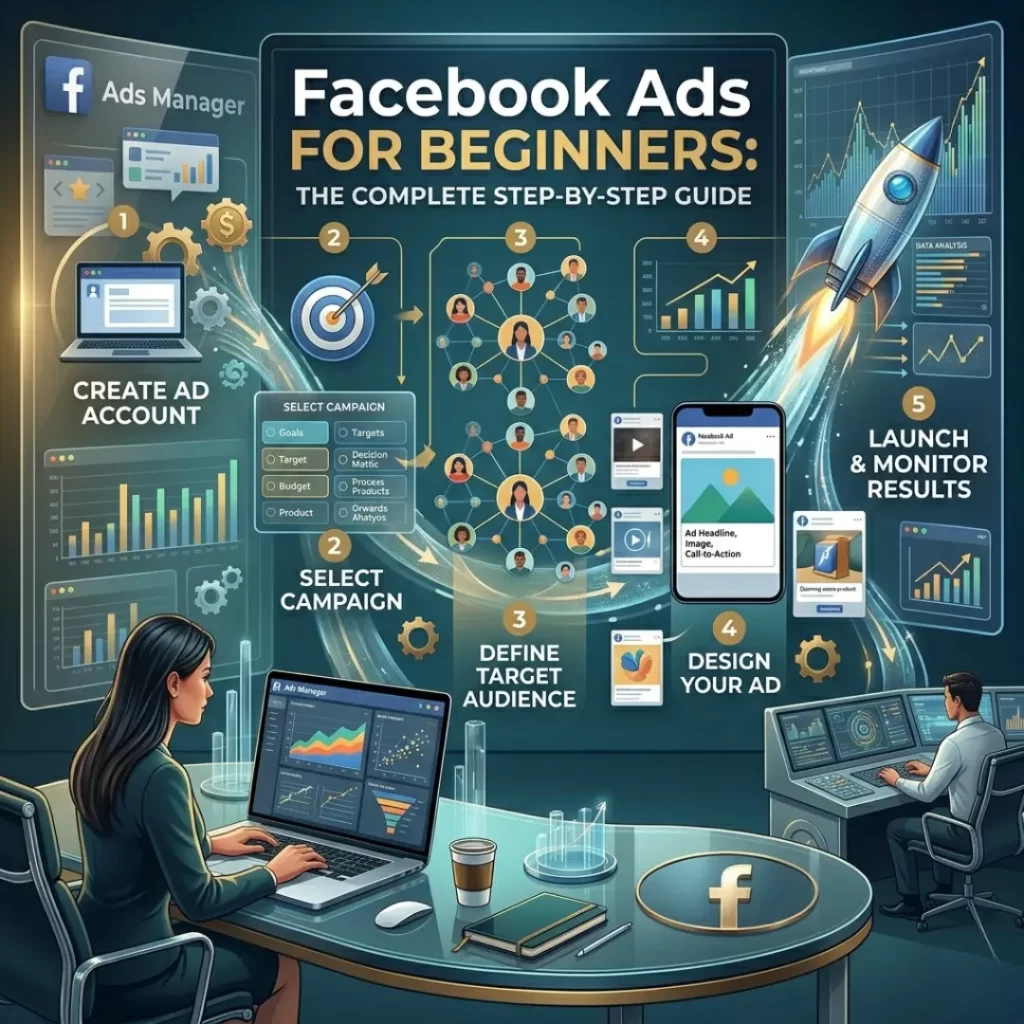
Facebook Ads for Beginners: The Complete Step-by-Step Guide

What Are Facebook Ads and Why Should You Care About Them Facebook Ads for Beginners is paid advertisements that allow you to reach very narrow audiences across Facebook, Instagram, and Messenger. Rather than targeting everyone, Facebook delivers your ad to people who are most likely to be interested in your product or service by using deep data. This is one of the most useful online marketing tools around. The potential here, in India, is huge. Facebook and Instagram have more than 400 million users. Their daily routine revolves around seeing reels, checking out updates, and buying things online. The power of Facebook (and Instagram) lies in the fact that it’s not comparable to traditional advertising channels like newspapers or billboards in terms of cost. Start with as little as ₹100–₹500 per day and you can see meaningful results. The beauty of Facebook Ads, especially for newcomers, is that you have much more control than you would in traditional advertising. You control who sees your ad, how much you are going to spend, and your objectives. You also receive comprehensive analytics showing clicks, impressions, and conversions. In other words, you can measure the success, learn from it, and improve without making costly mistakes. For small businesses and freelancers, Facebook Ads equal a level playing field where budget constraints aren’t a dealbreaker. Setting up Facebook Business Manager Ok, you’re ready to run ads, but first you need your Facebook Business Manager (i.e., your control panel). It’s where you add ad accounts, pages, your team access, and all your tracking tools. Think of it as a way to separate your personal profile from your business, and keep it together as you grow. Setting up is quick. Go to business.facebook.com, sign up, and create your business profile. Once inside you’ll create your ad account, set your currency (INR), and your time zone. Why? Because it impacts billing and reporting. Add a payment method (debit card, credit card, or net banking). Facebook bills you on a basis of ad spend (either when you hit your billing threshold, or at the end of the cycle). This is why beginners need to set a spending cap (so you’re not blown out during testing). Consider this process as building your shop before opening it up. Once it’s set, you’re ready to start pulling in customers. How Facebook Ads Work in Three Levels, And Why It Matters Facebook Ads for Beginners work in three levels: Campaign, Ad Set, and Ad. Why it matters At the campaign level, it is where you select your objective. What do you want to do? Traffic, Engagement, Leads or Conversions? This tells Facebook what to optimize for. Ad set level is where you target, budget and schedule. Who is your audience? Where is your audience? Age range, Interests and Behaviours. Budget and spend. Ad level is where you create the image, copy, headlines and captions. This is what your audience would see, and ultimately, what will affect performance. A strong image paired with clear benefit copy can drastically improve performance. When your Campaign, ad set and ad are all working together, you have a structured and targeted ad campaign. How to Select The Right Objective For Your Campaign Facebook divides its objectives into three buckets: Awareness, Consideration and Conversion Awareness is about reach and visibility Consideration is about calls to action, clicks, messages, etc. Conversion is about getting purchases, sign ups etc. In general, if you are a beginner, it is best to start with Traffic or Engagement campaigns. These will allow you to understand your audiences without having to figure out the complicated tracking solutions that Facebook offers. If you run a service based business, you can try Lead Generation or Messages campaign depending on how your customers communicate with you (It could be through WhatsApp in India). If you do not have data and jump straight into conversion, your ads are likely to perform poorly. Instead, try and build a funnel: first attract attention then create interest and finally convert. Audience Targeting in Facebook Ads Facebook Ads for Beginners offers one of the best targeting options. You can segment your audience based on demographics, interests and behaviours. For instance, a fitness brand can target the people who are interested in gyms and yoga, or in leading a healthy life. You can also build Custom Audiences i.e. people who have already interacted with your business; like your website visitors and Instagram followers. You can then build Lookalike Audiences on top of all this i.e. new users who are similar to your existing customers. In India, localised targeting is highly effective and works very well. Think of using regional languages, themes of festivals and localised content and stuff in your ads. Budgeting & Bidding Strategies Budgeting is easy. Start with a daily budget, say, ₹200–500. This way you can test out different strategies without risking too much money. Facebook uses automated bidding to fetch you the best results at your budget. You should not worry about manual bidding until you have some experience. The important thing to remember is consistency. Don’t try to spend a large amount at one time. Spend your budget for a few days, try to gather data and then optimise accordingly. Creating High-Converting Ad Creatives Now let’s talk about the creative. It is your ad’s visual or video. Since you are competing for attention in a crowded feed, it’s important to have something that grabs the attention of the user. The visual should be clear and of high quality. You can use a static image or a short video. Since we are in India, cultural visuals like festivals generally perform better. The ad copy should be simple, conversational and benefit-oriented. Highlight how your product can solve a problem rather than focusing on the product features. A clear CTA can help the user figure out what to do next. It can be an existing button like “Shop Now”, “Learn More” &c or a custom button like “Get Offer”. You should
AI in marketing, Paid Media, Performance Marketing

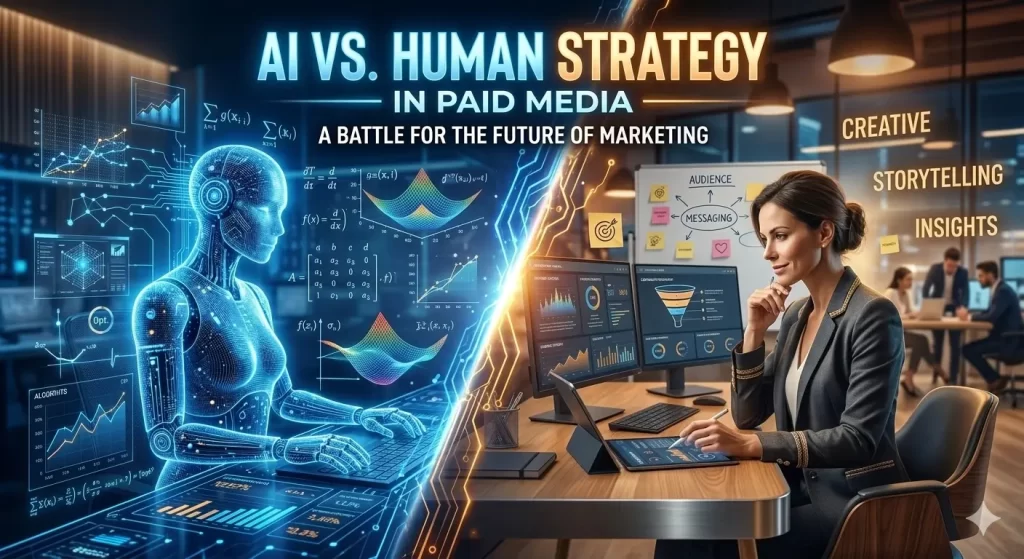
AI vs. Human Strategy in Paid Media: A Battle for the Future of Marketing

With every click costing money and ROI being the most important metric. The AI vs. Human Strategy debate in paid media highlights the strengths and weaknesses of human advertisers and AI systems. Can AI reach the required level of sophistication, or will advertising still rely on human creativity and intuition? As technology reshapes advertising, we must examine tools from Google and Adobe and ask, “What is the future of advertising? This growing tech gap makes many media professionals question whether automation will replace them. These technologies leave us anticipating the outcome between team AI and team human. While it might seem like a zero-sum game, the true outcome is actually a win-win.  Speed and Scale – AI Takes the Lead “I will never be replaced by a human.” Yes, I can automate the entire process of analytics. I can analyze 1000’s of bidding strategies, item clusters, and consumer behavior almost instantly. Everything I do is optimized with advanced technology, and my peers are equally as advanced. The scale at which we operate is simply unattainable by a human. I will continue to execute behavior analyses at milliseconds. Each moment I will continue to run any number of tests required to reach optimal output at the expected result. Let’s take real-time bidding (RTB). As a result of forecasting AI algorithms from The Trade Desk, supply-side factors other than audience reach, type of device, and even weather (e.g. rainy weather decrease in clicks of outdoor apparel ads). Marketers fear a fluid market, but I do not. People fear getting replaced, but I consider it as evolution. Marketers leaving me while I evolve will be just like blockbuster leaving Netflix behind. The Challenger “Human” – Context and Trust While heading towards the Utopia of AI, we have encountered strange occurrences. The aim of AI is to enhance and improve but is also the reason the internet has become so synthetic and noisy since the invention of the internet.  Generic output has become so common in the current consumer environment that the appetite of consumers has become even stronger for the other side of the spectrum.  This is where the human strategist comes in. The gap that AI will never fill is the ability to explain why audiences do things. AI will struggle to do this because it is beyond the operational reasoning of AI and typically requires some degree of emotional and sociological intelligence that are beyond the thinking of AI. The 2026 Reuters report predicts that publishers will limit themselves to AI content in the future and expand original and authentic content. AI is limited in activities that require it to be human or to possess human knowledge or understanding. In paid media, there is a trade off between brand safety and creative daring. While AI could optimize for brand safety by getting the lowest cost-per-click, it could also equally place a high end brand next to destructive content because the algorithm views it as “high traffic”. An ad is a reflection of a brand. If it tells a good story, a good ad could win the audience’s trust. AI can generate a good factual ad, but it takes a person to emotionally connect with the audience. Like one industry expert said, “people that use AI well will replace people that don’t use AI well”. AI as a Tool, Not a Replacement Instead of viewing AI as an adversary to human strategists, it makes more sense to view it as a powerful tool that amplifies what marketers do. Much of AI’s strengths lie in its ability to analyse data and automate processes. Because of this, AI performs repetitive tasks more efficiently, allowing human marketers to use their time to focus on higher-level aspects of campaigns, which is creativity, relationship development, and also emotional content. In this case, AI will be able to automate bidding and ad placements. Marketers, in this case, will be able to write, develop and create the ads that align, and fit with the brand, and emotionally connect and engage with the audience. Consider this: AI can optimize a campaign for more conversions, but only a human strategist can dictate the tone, content, and direction of that campaign. AI can execute and optimize the various components of the campaign, but it won’t have the vision behind the components. Strategists, for instance, eliciting the emotional responses in the audience, and being creative in the development of the campaign will create a significant amount of potential that AI can utilize. The Fear of AI Replacing Paid Media Marketers Paid media marketers losing their jobs due to the advancement of automation and AI tools is a justified concern. With the rapid adoption of automation tools and AI in the marketplace, marketers have a legitimate concern that their jobs will become obsolete, as the machines will be able to accomplish their work. However, the apprehension is likely misguided. AI will not be replacing human marketers, it will be supplementing their work. The adoption of AI technologies, in fact, requires marketers to develop different skills. Modern marketers must learn how to work with AI, leverage it to their advantage and, in some cases, even teach it to understand their specific business goals. Marketers who learn how to utilize AI will become more valuable to their employers, as the need for marketers who can work with AI is increasing. The AI vs Human Strategy in Paid Media Marketing Verdict – Collaborative Agency So, who loses the fight? Neither. With the notion of the winner being entirely outdated in 2026, we begin what is called the ‘Age of Collaborative Agency The marketing ecosystem is no longer described as a linear series of human-machine instructions. It is a “mesh of entangled intelligences”. The risk is not the takeover of AI, but the relinquishment of strategic control by human marketers to the “black box” of automation. The AI vs Human Strategy in Paid Media-winning model must be hybrid:   AI does Heavy Lifting:   Data crunching, bid optimization, audience

Scroll to Top