DIDM PITAMPURA

performance marketing

Facebook ads: step by step guide
Digital marketing, Facebook Ads, Performance Marketing

Facebook Ads for Beginners: The Complete Step-by-Step Guide

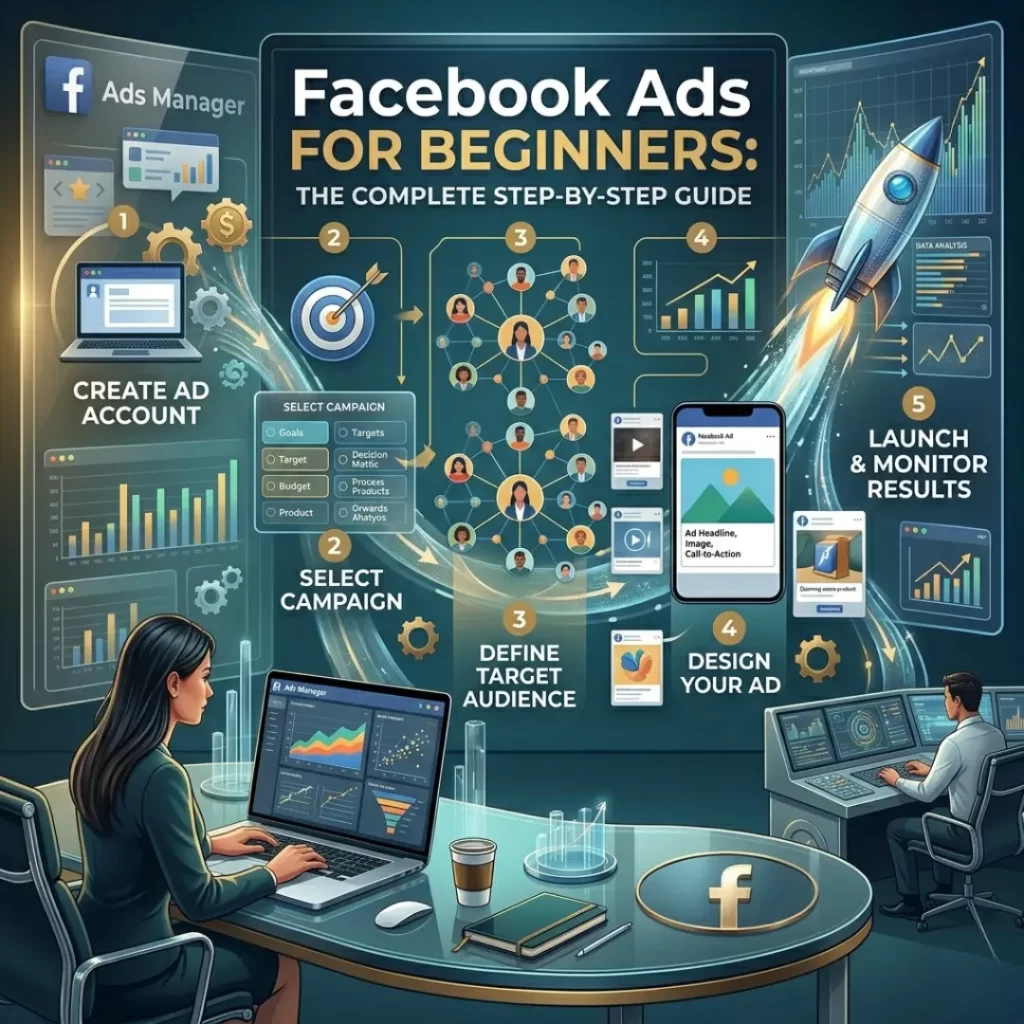
What Are Facebook Ads and Why Should You Care About Them Facebook Ads for Beginners is paid advertisements that allow you to reach very narrow audiences across Facebook, Instagram, and Messenger. Rather than targeting everyone, Facebook delivers your ad to people who are most likely to be interested in your product or service by using deep data. This is one of the most useful online marketing tools around. The potential here, in India, is huge. Facebook and Instagram have more than 400 million users. Their daily routine revolves around seeing reels, checking out updates, and buying things online. The power of Facebook (and Instagram) lies in the fact that it’s not comparable to traditional advertising channels like newspapers or billboards in terms of cost. Start with as little as ₹100–₹500 per day and you can see meaningful results. The beauty of Facebook Ads, especially for newcomers, is that you have much more control than you would in traditional advertising. You control who sees your ad, how much you are going to spend, and your objectives. You also receive comprehensive analytics showing clicks, impressions, and conversions. In other words, you can measure the success, learn from it, and improve without making costly mistakes. For small businesses and freelancers, Facebook Ads equal a level playing field where budget constraints aren’t a dealbreaker. Setting up Facebook Business Manager Ok, you’re ready to run ads, but first you need your Facebook Business Manager (i.e., your control panel). It’s where you add ad accounts, pages, your team access, and all your tracking tools. Think of it as a way to separate your personal profile from your business, and keep it together as you grow. Setting up is quick. Go to business.facebook.com, sign up, and create your business profile. Once inside you’ll create your ad account, set your currency (INR), and your time zone. Why? Because it impacts billing and reporting. Add a payment method (debit card, credit card, or net banking). Facebook bills you on a basis of ad spend (either when you hit your billing threshold, or at the end of the cycle). This is why beginners need to set a spending cap (so you’re not blown out during testing). Consider this process as building your shop before opening it up. Once it’s set, you’re ready to start pulling in customers. How Facebook Ads Work in Three Levels, And Why It Matters Facebook Ads for Beginners work in three levels: Campaign, Ad Set, and Ad. Why it matters At the campaign level, it is where you select your objective. What do you want to do? Traffic, Engagement, Leads or Conversions? This tells Facebook what to optimize for. Ad set level is where you target, budget and schedule. Who is your audience? Where is your audience? Age range, Interests and Behaviours. Budget and spend. Ad level is where you create the image, copy, headlines and captions. This is what your audience would see, and ultimately, what will affect performance. A strong image paired with clear benefit copy can drastically improve performance. When your Campaign, ad set and ad are all working together, you have a structured and targeted ad campaign. How to Select The Right Objective For Your Campaign Facebook divides its objectives into three buckets: Awareness, Consideration and Conversion Awareness is about reach and visibility Consideration is about calls to action, clicks, messages, etc. Conversion is about getting purchases, sign ups etc. In general, if you are a beginner, it is best to start with Traffic or Engagement campaigns. These will allow you to understand your audiences without having to figure out the complicated tracking solutions that Facebook offers. If you run a service based business, you can try Lead Generation or Messages campaign depending on how your customers communicate with you (It could be through WhatsApp in India). If you do not have data and jump straight into conversion, your ads are likely to perform poorly. Instead, try and build a funnel: first attract attention then create interest and finally convert. Audience Targeting in Facebook Ads Facebook Ads for Beginners offers one of the best targeting options. You can segment your audience based on demographics, interests and behaviours. For instance, a fitness brand can target the people who are interested in gyms and yoga, or in leading a healthy life. You can also build Custom Audiences i.e. people who have already interacted with your business; like your website visitors and Instagram followers. You can then build Lookalike Audiences on top of all this i.e. new users who are similar to your existing customers. In India, localised targeting is highly effective and works very well. Think of using regional languages, themes of festivals and localised content and stuff in your ads. Budgeting & Bidding Strategies Budgeting is easy. Start with a daily budget, say, ₹200–500. This way you can test out different strategies without risking too much money. Facebook uses automated bidding to fetch you the best results at your budget. You should not worry about manual bidding until you have some experience. The important thing to remember is consistency. Don’t try to spend a large amount at one time. Spend your budget for a few days, try to gather data and then optimise accordingly. Creating High-Converting Ad Creatives Now let’s talk about the creative. It is your ad’s visual or video. Since you are competing for attention in a crowded feed, it’s important to have something that grabs the attention of the user. The visual should be clear and of high quality. You can use a static image or a short video. Since we are in India, cultural visuals like festivals generally perform better. The ad copy should be simple, conversational and benefit-oriented. Highlight how your product can solve a problem rather than focusing on the product features. A clear CTA can help the user figure out what to do next. It can be an existing button like “Shop Now”, “Learn More” &c or a custom button like “Get Offer”. You should

Paid Ads Are Getting More Expensive in 2026
Digital marketing, Paid Media, Performance Marketing

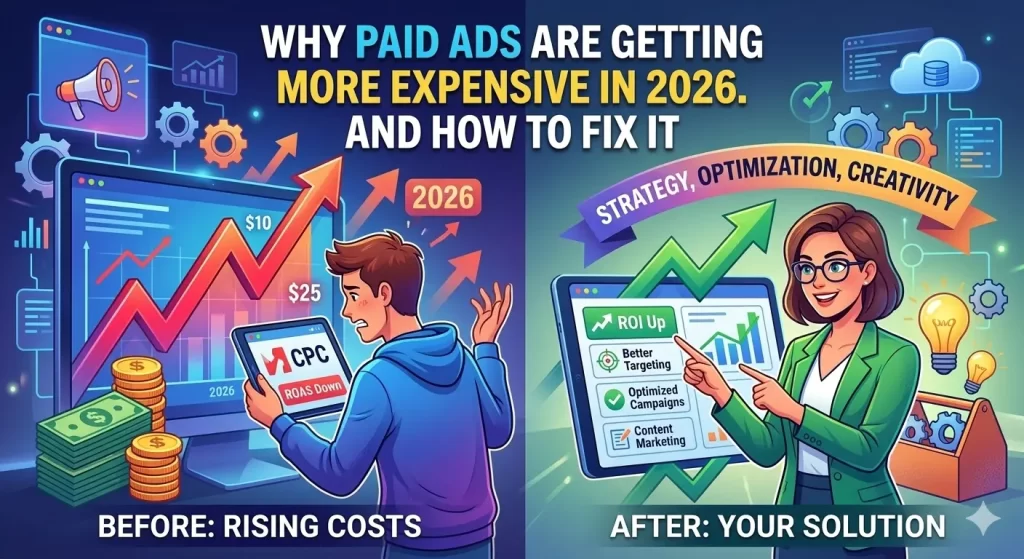
Why Paid Ads Are Getting More Expensive in 2026. And How to Fix It

Paid Ads Getting More Expensive. The golden age of cheap clicks is officially over. Managing digital ads lately has been a challenge. Your budget that has consistently brought you leads is now burning in a shorter time frame in greater amounts, and obtaining a single customer is more expensive each quarter. Advertising costs are increasing due to a perfect storm of economic changes, changes to ad platforms, and changes to technology. Digital marketers need to understand the how and why to develop proficiency and understanding of modern media. The Perfect Storm Behind Rising Digital Advertising Costs Increased Cost Per Click (CPC) is more about the structure of the digital ad ecosystem, rather than just how inflationary pressure is affecting the economy. Increased Competition Driving Up Paid Ad Costs The simplest and most straightforward answer is that there are just more advertisers in the marketplace. The most underlying cause of the cyclical downturn is economic recession, and in this case, the driving force is the demand outstrips supply. Digital ad spend grows year after year. It is unique to this new economy. There are more and more buyers in the digital ad marketplace.Data from across the industry shows that CPCs across all large platforms are 20–40% greater than 2 years prior. In competitive industries like SaaS, legal, and healthcare, keywords that previously cost only a few dollars have increased in cost, increasing customer acquisition costs across the board. Decline of Organic Reach Is Forcing Businesses Toward Paid Ads Paid clicks dominate competitive advertising opportunities because businesses have no choice. Hidden Budget Leaks That Make Paid Ads Even More Expensive Two factors, that must be addressed in order to optimize results control your spending, and cost you a great deal of money. The AI Bidding Black Box in Google and Meta Ads Paid Ads Getting More Expensive. The AI platforms work for and against you. In a fundamental way, Google’s move to Performance Max and Meta’s move to automation have increased the complexity of managing your budgets. These AI systems need an enormous amount of data to ‘learn.’ Budget restrictions or insufficient data tracking lead to the AI system making very broad and highly expensive assumptions that fail to differentiate between prospecting and remarketing by bidding on users that are not going to buy. This means you are paying high costs for traffic that the algorithm deems valuable but which has no likelihood of conversion. Poor Targeting Drains Your Budget Out of Control In 2026, efficient or sophisticated targeted advertising will seem like a miracle. Targeting by broad interest categories or by a manual CSV upload will likely waste as much as 50% of your remaining budget. Smarter Advertising Strategies to Reduce Rising Ad Costs The answer is not to stop advertising, but to start advertising smarter. To combat ever-increasing costs and to eliminate waste, your advertising must be smart. Feed the AI, Don’t Fight It It is impossible to defeat AI algorithms, but, within the advertising platform, you are able to control the algorithm. You must give the algorithm what it requires. Sharpening conversion tracking accuracy takes precedence. Automated bidding requires 15 to 30 conversions a month to learn effectively. When utilizing Performance Max or Meta Advantage+, provide as much high-value information as possible regarding search themes, audience signals, and a wide range of creative resources. Why First Party Data Is the Future of Paid Advertising In today’s privacy-centered era, your business’s customer information is invaluable. Implement a real-time CRM and advertising platform synchronization tool. Automatically exclude current customers and active opportunities from prospecting campaigns. One business used dynamically automated exclusion lists to bring their LinkedIn CPL down from $250 to $25. On Meta, personalize the matched email addresses to the customer, increasing the match rate from 30 to over 70%, ensuring an effective lookalike audience. Transform Your Creative Strategy In 2026, the key to optimization cost is creative diversity. Very small accounts (<$2k/month) should refresh creative monthly. Larger accounts (>2k/month) should refresh creative weekly. If CPMs are rising with no other changes, it is probable that the creative is fatigued. Meta’s Dynamic Creative tools can be used so that advertisers can upload multiple creatives (images, videos, headlines, and texts) and the AI can optimize and find the best combinations for the best users. This can dramatically reduce the cost of ads. In one instance, the cost of ads dropped from $86 to $13.87 per conversion. When creating LinkedIn ads, it is important to create ads with more than just a sales pitch. Use story-telling and “thought leader” ads that educate and offer insight as they are much more successful than traditional ads. Full Funnel Marketing Strategy to Control Paid Advertising Costs I understand it is tempting to cut upper-funnel budgets. This is a mistake. Allocate 20-40% for demand creation including YouTube, TikTok, and native ads. Cutting upper funnel budgets to over focus on lower funnel (last-click) budgets like branded search may look good in the short term, but it starves your future pipeline. In a time of experimentation, it is best to allocate 5-10% to try new platforms, creative formats, and audience strategies. Diversification Strategies to Reduce Dependence on Paid Ads Open your paid advertising budget and invest it in channels that compound (save in the long run). Optimize your AI-optimized content for traffic. This increases your brand mentions to give you traffic in a world with increasingly little click activity. Organic search will give you the search ROI you have been looking for. Paid search costs are rising, so focus on a search that will build your authority on a topic and structure the content for AI readability. Paid Ads Getting More Expensive — But Smart Marketers Will Still Win The age of inexpensive, simple traffic generation is at an end. However, marketing that is intelligent and profitable is still possible. Winning brands in 2026 will not be those with the largest budgets, but rather those with the most effective strategies. With a good understanding of AI, a focus on creativity and the smart use of first party data, all of the concerns over increasing costs and

AI in marketing, AI tools, Digital marketing, Uncategorized

AI vs Digital Marketers: Will AI Replace Digital Marketing Jobs in 2026?

The year is 2026, and the digital landscape looks vastly different from what it did just a few years ago. We’ve moved past the initial “AI hype” and entered a phase of deep integration. For students and beginners eyeing a career in digital marketing, the burning question remains: “Am I studying for a job that won’t exist by the time I graduate? Will AI Really Replace Digital Marketing Jobs?” The fear is real. We see AI writing blogs, designing logos, and even managing ad budgets with terrifying precision. But before you switch your major, let’s look at the facts. AI isn’t here to take your desk; it’s here to upgrade your keyboard. What Role AI Plays in Digital Marketing in 2026 By 2026, AI has shifted from being a “cool feature” to the very engine that powers marketing. It isn’t just about chatbots anymore; it’s about predictive intelligence and hyper-personalization. Top AI Tools Used by Digital Marketers in 2026 To survive and thrive in 2026, you need to be a “pilot” of these powerful tools. Here are the industry standards for any beginner: Tool Category Leading Tools in 2026 Primary Use Case All-in-One AI ChatGPT-5 / Gemini Strategy, brainstorming, and complex data analysis. Visual Design Canva AI / Midjourney Generating high-fidelity brand assets and instant social graphics. Video Production Veo / Sora 2 Creating cinematic brand videos and social ads from text prompts. Copywriting Jasper / Copy.ai Maintaining a consistent brand voice across thousands of product descriptions. SEO Optimization Surfer SEO / MarketMuse Analyzing content gaps and optimizing for “Answer Engines.” Can AI Completely Replace Digital Marketers? The short answer is no, AI cannot replace Digital Marketers Jobs. While AI can execute tasks, it lacks the Human Moat. Logic can be automated; soul cannot. Here is why the human marketer is still the most valuable asset: 1. The “Vibe” Check AI is a statistical machine. It knows what has worked in the past, but it cannot predict the next big cultural “vibe.” It doesn’t understand “cringe,” and it can’t feel the subtle shift in social media sentiment that turns a brand into a household name. 2. Strategic Empathy Marketing is about solving human problems. AI can analyze data showing that “Users like blue buttons,” but it can’t understand the emotional “why” behind a purchase. Humans possess empathy—the ability to connect a product to a person’s identity and struggles. 3. Ethical Oversight AI is prone to “hallucinations” and bias. In 2026, the role of a marketer is often that of an Editor-in-Chief. You must ensure that the AI-generated content is accurate, ethically sound, and doesn’t violate copyright or brand values. Digital Marketing Skills That Will Still Be Valuable in the AI Era If you want to be “un-replaceable,” don’t try to out-calculate the machine. Instead, double down on these human-centric skills: How Students Can Prepare for a Career in Digital Marketing with AI If you are starting today, don’t just “study” marketing—practice it with AI as your intern. Future of Digital Marketing Careers The demand for digital marketers is actually growing, not shrinking. However, the nature of the job has shifted. We are seeing a massive explosion in roles like: The entry-level “grunt work” (like manual data entry or basic keyword research) is disappearing, but the “high-value” roles are more lucrative than ever. Conclusion AI is not your replacement; it is your superpower. In 2026, the best digital marketers aren’t the ones who fear the machine—they are the ones who know how to drive it. By combining your human creativity and empathy with AI’s speed and scale, you become a marketer who can do the work of an entire 2020-era agency by yourself.

Scroll to Top